Resources & Media
This section brings together Blanboz’s published insights across articles, social media contributions, panel discussions, presentations and other industry engagements. This section provides access to previous material where we share practical experience, market observations and technical perspectives from our work in energy storage.
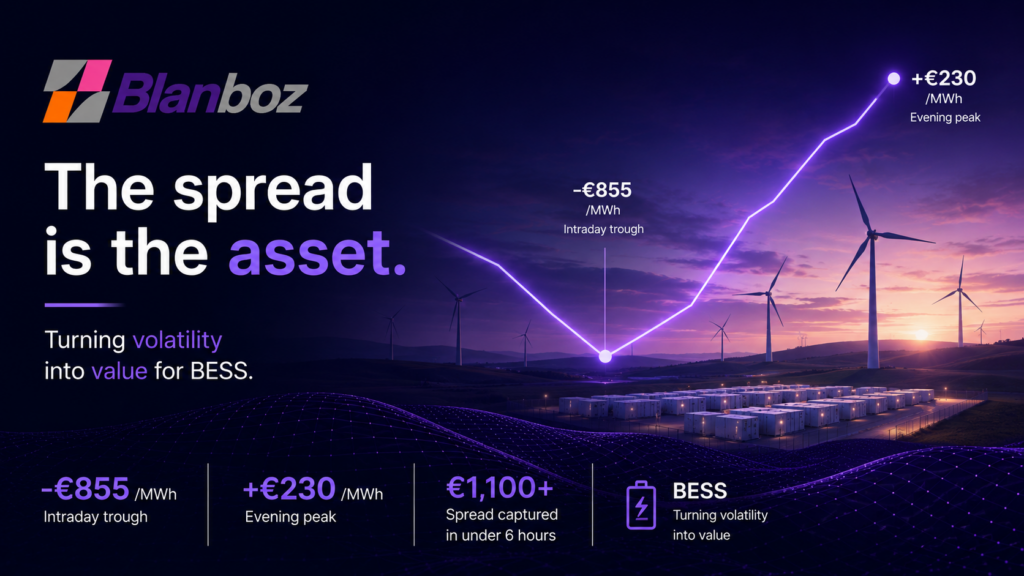
As negative prices become more frequent across Europe, they are offering an increasingly clear signal about where power system value now lies.
This article explores what that means for BESS design, optimisation and commercial structure — and why capturing value increasingly depends on flexibility and precision.
👉 Read the full article here
16:32 – 24:07 ← Andrés Blanco - First main speaking segment (about 7.5 minutes).
- 16:32 – 17:55: Introduction + optimism about Spain’s potential and need for market liquidity.
- 17:55 – 20:07: Need for fixed-price frameworks to handle volatility; focus on transmission-level congestion relief (UK comparison).
- 20:07 – 23:18: Critique of current capacity markets and recommendation for hybrid models that reward flexibility and response times (drawing from UK, Germany, Italy).
- 23:18 – 24:07: Role of arbitrage and balancing to solve distribution/transmission issues.
31:26 – 37:50 ← Andrés Blanco - Second main speaking segment (about 6.5 minutes).
- 31:26 – 33:18: Lessons from UK/Germany market evolution and the shift toward energy arbitrage + new services.
- 33:18 – 35:18: Opportunities in inertia/reactive power; grid-forming not always essential (grid-following often sufficient); upcoming Spanish grid code changes.
- 35:18 – 37:50: Prediction of rapid growth once regulations stabilize + advice for developers.
Key Speakers
- Andrés Blanco (Blanboz Limited) – Spain-specific recommendations
- Rafael Velasco (Moderator)
- María Ángeles (GPG/Natur group) – Australian market
- Jacopo Otosoni (European Battery Association) – EU regulatory trends
Main Discussion Points
A panel discussion on international battery energy storage (BESS) experiences and practical lessons for accelerating deployment in Spain.
- Australian Market (María Ángeles) Rigorous 1–2 year AEMO grid connection with detailed modeling and staged testing. Revenue from energy, regulation, and fast contingency services via 5-minute bidding and optimizers.
- European Context (Jacopo Otosoni) Service cannibalization, new EU codes (2027–2028), post-blackout rules, and high-value ancillary services (e.g., congestion management up to 30% of revenue). Shift toward merchant models and grid-forming capabilities.
- Recommendations for Spain (Andrés Blanco & panel) Create liquid, stable frameworks to reduce volatility; prioritize transmission-level projects; reform capacity markets to reward flexibility (not just power); adopt hybrid revenue models from UK/Germany/Italy; plan early for advanced grid codes and optimizers.
- Broader Takeaways Leading markets succeed with clear connection processes, diverse paid services, and predictable rules that value grid support. Spain has strong renewables and talent, but needs bankable regulations to unlock rapid BESS growth.
Overall Conclusion from the Panel
Successful BESS deployment depends on robust grid connections, multiple remunerated services (especially fast response and congestion relief), and stable regulations that reward flexibility. Spain can accelerate by adapting proven models from Australia, UK, Germany, and Italy—particularly through capacity market reform and early grid-forming planning—to integrate more renewables reliably and attract investment.
🚨 Big Drop in UK Capacity Market Auction – What It Means for Battery Storage Projects
The latest T-4 Capacity Market auction for 2029/30 has just cleared at £27.10/kW/year — a dramatic 50%+ drop from recent highs.
With over 40 GW procured (including 1.2 GW of battery storage), the oversupply driven by refurbished gas plants has pushed prices sharply lower.
For BESS developers, this signals lower stable revenue, tighter project economics, and a greater need to stack merchant, balancing, and other services.
Want the full breakdown and practical implications for your projects?