UK BESS Grid Services - Timelines & Responsibilities (Follow Up!)
Following the success of our recent article on UK BESS Grid Services (https://blanboz.com/blog/uk-bess-grid-services), which generated significant interest and enquiries, we’ve received many questions about the practical steps involved in registering battery energy storage systems (BESS) with the National Electricity System Operator (NESO) services. To address this, we’re sharing our insights and experience to help developers navigate the process and streamline their BESS projects. We recommend reading this post and using our previous article on Grid Services as a complementary resource.
As previously explained in our article Grid Services, BESS can generate revenues by participating in various UK energy and grid service markets. These markets vary in maturity, with some well-established, others being phased out, and new ones emerging. We advise clients to monitor the roadmap development outlined by the NESO closely[1].
Blanboz has prepared the anticipated project timelines and the division of responsibility for the tasks required for BESS projects (tailored for those projects connecting directly to the electricity transmission network). This article aims to assist developers in understanding the process for delivering grid services for their BESS project in the UK, focusing on compliance and time requirements, as well as the developers' and their appointed contractors' responsibilities.
This high-level guidance is prepared on our extensive project experience with both UK and global BESS projects, as well as NESO guidance. The following grid services are covered:
- Balancing Mechanism.
- Wholesale Market.
- Frequency Response Services.
- Reactive Power Services.
- Restoration Services.
- Capacity Market.
For tailored support in navigating these evolving opportunities, we invite you to get in touch with our team. Whether you're in the early stages of project development or seeking to optimise an operational BESS, we offer bespoke guidance to help you unlock its full potential. We’re specialised technical advisors for all things BESS. Extensive experience working in the UK and globally across various stages of projects - feasibility, development, pre-construction, construction, factory acceptance testing, commissioning, testing and operations.
Our experts are on hand to ensure your project is strategically positioned to access and benefit from all available grid services, in alignment with the latest NESO roadmap and market developments. Please contact Harry Thomson at h.thomson@blanboz.com or Andres Blanco at a.blanco@blanboz.com to discuss how we can support your project.
[1] https://www.neso.energy/document/358126/download
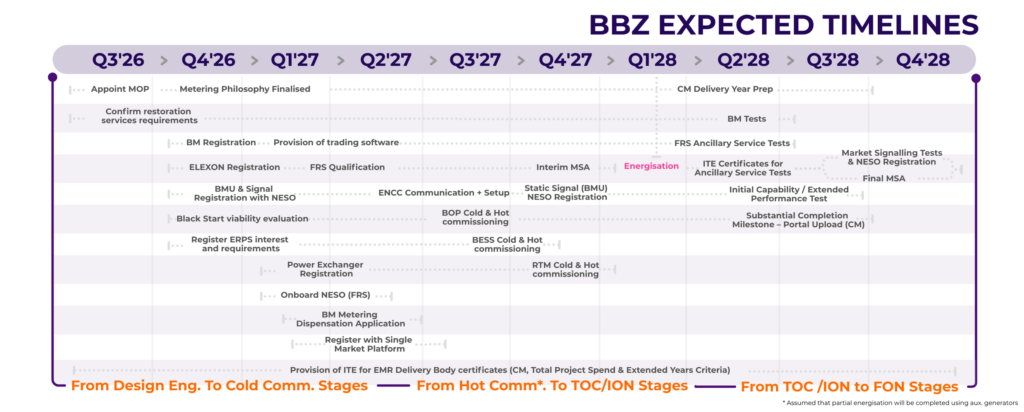
The timeline in Figure 1 provides a high-level overview of the key activities, milestones, and tasks required for a BESS project to deliver NESO grid services. Figure 1 shows a BESS project progressing from financial closure of its supply and construction contracts through design engineering and commissioning, and finally to operations.
The anticipated timeline is structured for a BESS project targeting commercial operations at the end of 2028, assuming a Capacity Market agreement is in place for the 2029 Delivery Year, allowing for two years from notice to proceed.
Whilst larger projects require longer construction and commissioning, the process to ensure the BESS project can deliver grid services should not vary significantly. This timeline was prepared for medium- to large-sized projects (150-500 MW); however, it is subject to factors such as location, the complexity of the project dispatch configuration, and the experience of the developer and contractors involved.
To mitigate the risk of delays that could postpone operations and impact revenue generation, it is advised that developers contact NESO and Elexon as soon as reasonably possible. Early engagement allows non-standard issues, such as multi-Balancing Mechanism Unit (BMU) metering or non-traditional BMU sizing, to be identified. It builds time buffers for an iterative design process, enabling seamless market entry.
The majority of developers will need to lean on their appointed project stakeholders to lead or support aspects of the tasks to comply with NESO requirements (further detailed in Figure 2). The most critical stakeholders are:
- BESS Supplier.
- Balance of Plant (BOP) Contractor.
- Meter Operator Provider (MOP) or Authorised Meter Provider.
- Route to Market (RTM) Provider.
- And finally, Blanboz (your trusted technical consultant!).
It is crucial for project success that there is a coordinated approach to delivering the project across all stakeholders – especially where there are interfaces between scopes of work and/or equipment. This is where the value of a thorough tender evaluation (Blanboz can definitely develop this for you) is captured, and the experience and expertise of contractors shine.
Division of Responsibility
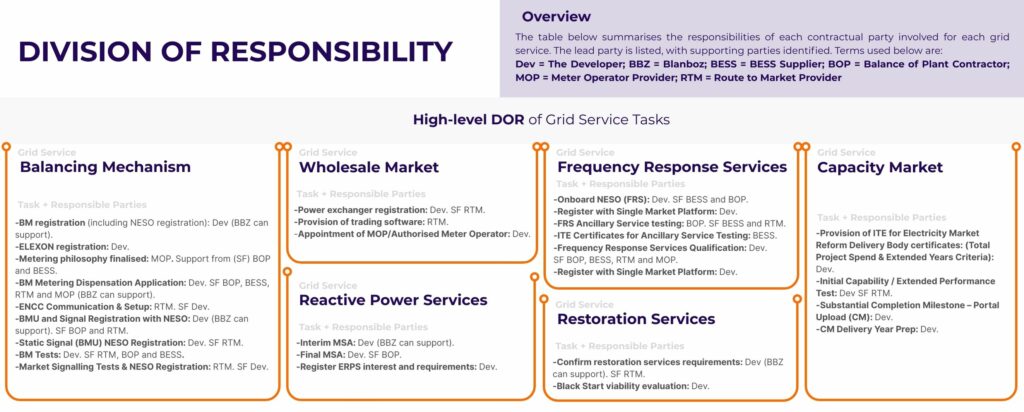
The division of responsibility table (Figure 2) outlines the expected allocation of key tasks across project stakeholders for allowing the delivery of NESO grid services, ensuring clear accountability from design through to operations. Each service has distinct requirements, including registration with governing bodies, establishing dispatch communication protocols, defining test procedures, obtaining Independent Technical Expert (ITE) certification, developing project models/studies, and more.
The developer must ensure that the responsibilities of these tasks are captured in the contracts with project stakeholders, defining single-party accountability and interface obligations. Blanboz recommends that this is captured through both the written contract (employer’s requirements, minimum functional specifications, etc.) and through a division of responsibility matrix (e.g. RACI matrix). The contract is the developer’s tool for preventing conflicts and enforcing ownership of responsibilities once the project has reached financial closure and contractors begin delivering their scopes of work. Risks the developer faces if there are no airtight contracts include delays to project milestones and commercial operations, non-compliance penalties, or shortfalls in initial revenue generation due to non-compliance with all intended grid services requirements.
The task requirements to deliver all intended grid services are typically split among multiple parties (as previously listed), with a single party accountable for the task's success. This is shown in Figure 2 with the lead party stated, followed by the supporting parties (SF).
In summary, this guidance outlines the anticipated BESS project timeline to allow for the successful completion of grid service compliance and commercial operations. The timeline highlights the need for proactive planning and organisation to manage multiple activities simultaneously. Preventing delays requires early coordination among stakeholders to foster collaborative teamwork. This leads to the Division of Responsibility, which highlights how contracts must define ownership and support for tasks necessary to achieve NESO compliance. Grid service compliance is a complex process and demands strong organisation to navigate regulatory bodies, protocols and testing protocols.
In conclusion, this entire process begins much earlier in a project's development. Suppose the foundations of a project are weak, such as unfit and/or unenforceable contracts, inexperienced and unknowledgeable contractors appointed, unachievable planning conditions issued, inappropriate dispatch and communication philosophy, or a lack of commercial protection for developers if aspects go awry. In that case, it is much more difficult to rectify later (with lengthy delays or additional costs). We strongly recommend that developers seek expert guidance early on to drive project success and achieve projected financial returns – and there’s no one better than Blanboz- Think BESS, think Blanboz!. At Blanboz, we understand the unique challenges that come with managing the technical complexity of BESS projects during the development, construction and operational phases. Our track record speaks for itself, and we’ve spearheaded some of the UK’s first BESS projects, including significant distribution- and transmission-connected initiatives exceeding 500 MW/1 GWh per project, totalling over 12 GWh worldwide.

Harry Thomson BEng AMIMechE - BESS Project Consultant
Project consultant with over two years of experience in the renewable energy industry, specialising in BESS. Having graduated in 2023 and taking an interest in energy storage after writing my honours project “An Investigation Into Future Electrical Grids and The Increasing Role of Energy Storage”, I have been working as a consultant in a BESS Engineer and Assistant Project Manager capacity for developers and lenders. During this time, I have collaborated closely with client teams to successfully secure the signing of over 4.1 GWh of BESS supply agreements, driving project delivery through technical and commercial guidance. My experience includes the early stages of project development, including preparing technical drawings and reports for DCO submissions for hybrid developments.

Andres Blanco MEng MSc CEng MIET – BESS Project Consultant I Managing Director
With over 15 years of experience in the renewable energy industry, I am a well-rounded chartered engineer in the UK. For the past ten years, I have specialised in the BESS sector, a self-proclaimed BESS Master. As a technical lead, I have overseen the successful execution of projects worth 12 GWh of BESS and 7.5 GWp of solar PV globally. Experienced with the majority of cell manufacturers and BESS integrators in the market. Technical expert with solid knowledge from early design and development to project implementation, construction, and commissioning of BESS projects. Highly capable in commercial integration and procurement, providing advisory services in technical reviews, compliance with different energy markets and grid services across the UK and EMEA region.