Market Insights | Constraint Management & European Flexibility
There Is No Availability Fee
What GB's constraint contracts really pay for, why they are not the annuity Italy sold, and why the battery case is harder than the market assumes
Overview
NESO published the CMIS Scotland service specification in April 2026. One line in it undoes most of the commercial analysis written about constraint management to date. There is no availability fee for this service.
The scheme pays two things. An arming fee in £/MWh, earned only on energy exported while NESO has armed the asset to the tripping scheme. And a one-off intertrip fee, payable if a fault occurs during an armed period. NESO assesses the likelihood of that fault at once in 29 years and divides the submitted trip fee by 29 in its own tender evaluation. At that assumption, the intertrip fee contributes little expected value relative to the arming-fee stream unless the submitted trip fee is unusually large. The contract is, in practice, the arming fee.
This matters because a capacity payment and a volume-linked contingent payment are different financial instruments. A capacity payment is a fixed annuity that can be levered. An arming fee is a short option position whose premium accrues only in the states of the world where the option is closest to exercise. You are not paid to stand ready. You are paid while you stand exposed.
Our view: The binding commercial question in CMIS is not eligibility and not the headline rate. It is how many hours a year you will be armed while exporting, what that exported MWh was worth in its best alternative use, and how a locational effectiveness factor buried in the evaluation formula divides your bid before NESO ranks it. BESS (Battery energy storage systems) score badly on the first and expensively on the second, which is the harder problem to fix.
What the contract really pays
CMIS Scotland is tendered as two lots. Lot 1 covers the B2, B4 and B5 boundaries through mid and south Scotland, using a new B2-B5 Operational Tripping Scheme. Lot 2 covers B6, following on from the existing service. A separate CMIS EC5-Enduring tender covers East Anglia. Treating CMIS as a single B6 scheme understates the addressable volume by a factor of roughly 3, and misses that the 2 Scottish lots have materially different technical specifications.
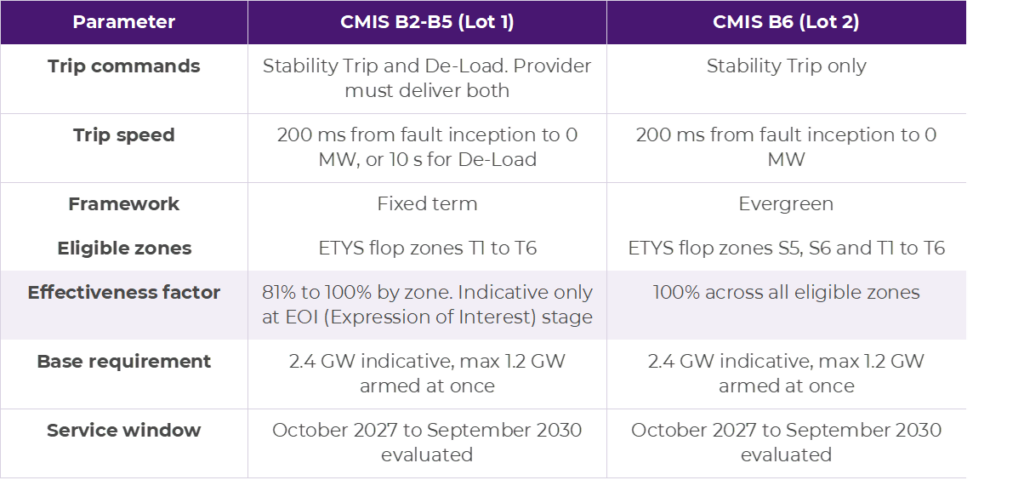
Source: NESO, CMIS Scotland Service Specifications, Version 1 (Consultation and EOI Stage), 13 April 2026. Effectiveness factors are illustrative pending the ITT (Invitation to Tender) phase.
NESO reports the existing B6 service has saved consumers over £130 million and avoided 420,000 t CO₂ since April 2022. The mechanism works. The question is who it works for.
The options structure, stated correctly
A constraint contract is an option, but the developer is short it, not long. NESO holds the exercise right. The provider writes the option, collects premium while the position is live, and delivers physical curtailment on demand.
More precisely, the provider writes a strip of knock-in options with no cap on the number of exercises, triggered by a circuit fault rather than by price. NESO states there is no maximum limit on the number of intertrips, so the provider's exercise exposure is not contractually bounded. It is only tolerable because the trigger frequency is estimated at once in 29 years.
The value of the position over a service year is:

Three consequences follow, and none of them appear in the market commentary we have seen.
- The arming indicator is endogenous, so this is a bid optimisation, not a valuation
NESO’s control room arms the parties that expect to generate during the constraint and are cheaper to arm than balancing mechanism curtailment. Raising your arming fee raises revenue per armed megawatt-hour and lowers the probability of being armed at all. There is an interior optimum. Bidding the cap is not a conservative choice, it is a choice to be armed rarely.
- The fee cap flexes monthly, and few model it that way
The submitted arming fee sets a ceiling. The provider may reduce it during the year to compete for arming hours, then revert within the cap. That converts a static contract into a live optimisation. The correct strategy is to undercut when the alternative use of the megawatt-hour is cheap, and price up when it is not. Nobody we have spoken to is modelling CMIS this way. It is worth more than the headline framing implies, and it rewards operators with intraday dispatch intelligence.
- The carry cost is negatively correlated with the trigger, which reduces it
NESO states that B2-B5 and B6 constraints are most often active when wind is high. High wind depresses wholesale prices. The megawatt-hour you forgo is therefore systematically cheaper than an unconditional average would suggest. Taking the expectation of the carry cost and the expectation of the arming indicator separately overstates the cost. The covariance term is the value. This cuts the other way for ancillary services, where low-inertia high-wind conditions can lift response prices, so the two components must be decomposed, not averaged together.
Why the invitation names wind
NESO is inviting wind farms with a registered Transmission Entry Capacity greater than 50 MW to express interest, in light of the need to preserve inertia levels on the network. That phrasing is in both lots of the service specification. It is not incidental.
The arming fee is paid per megawatt-hour exported while armed. An asset that exports whenever the wind blows accumulates armed export hours passively. A BESS optimised against wholesale and ancillary price signals is frequently idle, charging, or holding headroom for another market during the overnight, high-wind periods when the boundary binds. The revenue mechanism selects for the wind profile by construction.
The service stacking rules compound this. CMIS may be held in parallel with Dynamic Containment, STOR and similar products, but the provider must declare itself unavailable for CMIS in every settlement period it is contracted for a response or reserve service. This is not a technical incompatibility with the frequency response suite. It is a contractual mutual exclusion at settlement-period granularity, and because the arming fee is volume-linked, every declared-unavailable period is a period of exactly zero CMIS revenue. The carry cost is therefore not an estimate. It is directly observable from your own dispatch record.
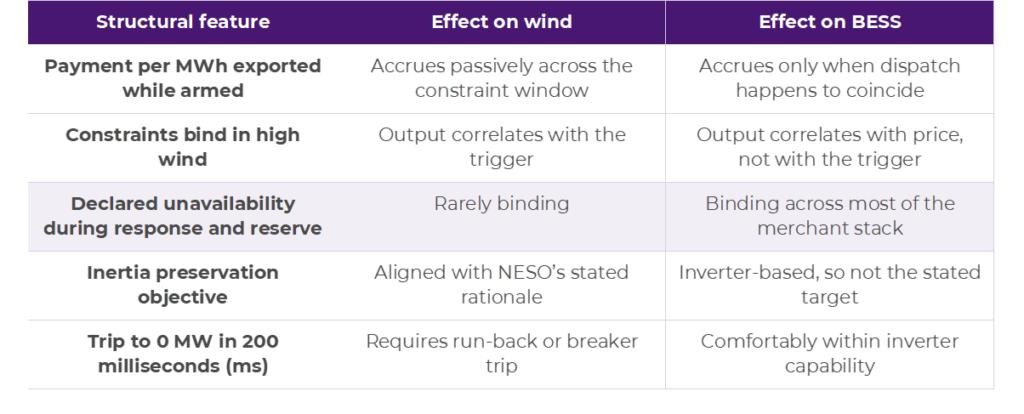
Fast tripping makes batteries eligible. Everything that makes the contract worth money runs the other way.
The honest conclusion is that the eligibility case for BESS is trivial and the commercial case is adverse under the current design. That is a finding, not a failure. It tells a developer where to spend consultation effort rather than tender effort.
Locational pricing has already arrived
The narrative that constraint value will eventually be priced by location is out of date. It is already in the evaluation formula. NESO assesses each bid as:

The effectiveness factor sits in the denominator. A lower factor inflates your assessed cost and pushes you down the ranking. On the indicative B2-B5 figures, a bid in zone T4b at 81% is assessed as though it were roughly 23% more expensive than an identical bid in zone T5 at 100%. Two assets with identical technology, identical cost base and identical bid price receive different outcomes because of where they sit relative to the boundary.
That is locational value, priced, live, and settled through a tender formula rather than through a nodal market. It is a smaller and quieter version of the same economics that a zonal reform would deliver, and it is operating now. The B6 lot, by contrast, applies 100% across every eligible zone, so location is neutral within it. The two lots therefore demand different bidding strategies, which is not a distinction the market is currently drawing.
Note also that the effectiveness factors published at consultation stage are explicitly illustrative. The binding figures arrive at Invitation to Tender. For an asset in a marginal zone, that single number moves the economics more than any assumption a developer will make about wholesale prices.
Underpriced risks in the current specification
- Shared circuit breaker dependency. If another asset sits behind the same circuit breaker and does not bid, or bids and fails the feasibility study, you can be removed from the tender to avoid tripping a non-contracted party. Your commercial outcome depends on a third party’s decision you do not control.
- Unbounded exercise count. No annual cap on intertrips. 29-year frequency is an estimate NESO explicitly declines to warrant.
- Post-trip lock at zero. Output must be held at 0 MW until the control room instructs otherwise. Beyond three settlement periods a Bid Offer Acceptance applies, priced off prevailing Physical Notification and bid-offer data, so recovery revenue is not contracted.
- ANM primacy. Distribution-connected assets in an Active Network Management scheme fail assessment without a documented primacy rule in place by the tender submission date.
- Non-firm connection clauses. A non-firm clause in the Bilateral Connection Agreement may take precedence over CMIS and reduce assessed availability. Assessment uses firm connection detail only.
- Connection deadline. The OTS connection must complete by September 2029 or the contract may dissolve. Intertrip connection costs beyond the Transmission Owner’s circuit breaker fall on the provider.
- Termination on trip speed. If 200 ms from fault inception is not demonstrated, NESO reserves the right to terminate the awarded contract.
The sections above close the GB case. The remainder benchmarks CMIS against Italy and the other European markets.
What Italy already proved about contracted revenue
Terna, Italy's transmission system operator, held the first MACSE auction on 30 September 2025 for 2028 delivery. 10 gigawatt-hours cleared, oversubscribed roughly 4x, at a weighted average of €12,959 per MWh-year against a reserve premium of €37,000. 14 BESS projects totalling around 1,491 MW and 9,968 MWh, averaging 6.6 hours duration, on fifteen-year contracts.
Developers surrendered roughly 65% of the available ceiling premium to secure fifteen years of contracted cashflow. That is a measurement, not an opinion. It is the market’s revealed price for bankability, and it is large.
This is the point most carry-cost analysis misses. Comparing contracted revenue against forgone merchant revenue on an expected-value basis is the wrong test for a levered developer. Contracted cashflow supports materially more debt than P50 merchant revenue after lender haircuts, and the resulting reduction in weighted average cost of capital can make a position accretive to equity even where it looks dilutive on a gross revenue comparison. The correct test is levered equity return, not revenue arithmetic. The Italian result is what happens when a market prices that correctly and competes the premium away.
The corollary for GB is uncomfortable. CMIS pays no availability fee and no capacity payment. It offers none of the bankability that made MACSE worth 65% of its ceiling. A CMIS position is contingent, volume-linked and terminable. It should not be underwritten as contracted revenue, and lenders will not treat it as such.
Five markets, one curve
GB, Germany, Italy, Iberia and the Nordics are answering the same question from different points on one maturity curve. How do you price the capacity built to move power, once the capacity connected to the grid has stopped being the binding constraint.
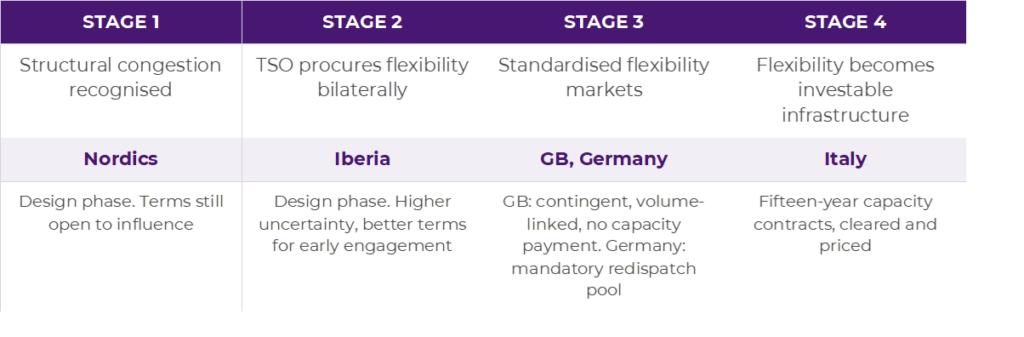
Blanboz assessment. Stage assignment reflects whether flexibility is procured administratively, competitively, or as a financeable long-dated contract.
We have moved GB down from Stage 3 in our earlier assessment. The distinction that matters is not whether a market is standardised but whether what it sells can be financed. On that test CMIS is a balancing product with an auction wrapped around it, not investable infrastructure. Germany sits alongside it: Redispatch 2.0 is a mandatory pool with grid-forming contracts emerging on top, which is procurement rather than investment.
Where this goes
Renewable connection queues are growing faster than transmission capacity can be permitted and built. Grid reinforcement operates on an 8–12-year cycle that no policy intervention materially compresses. That mismatch outlives the investment horizon of any BESS financed in the next 5 years. The question is not whether constraint mechanisms proliferate. It is what mechanisms emerge to allocate a fixed transmission resource, and which of them are financeable.
- Locational value moves from evaluation formulas into headline prices. It is already priced inside CMIS through the effectiveness factor. The next step is exposing it in the settled rate rather than burying it in the ranking.
- Capacity-based structures displace volume-based ones where finance is required. MACSE cleared because it sells an annuity. Arming fees cannot support debt. Schemes that want new build rather than existing assets will converge on the MACSE form.
- Merchant and contracted flexibility split into incompatible strategies at the same MW. An asset cannot hold a symmetric reserve band and an intertrip-to-zero position in the same settlement period. Portfolios will specialise rather than hedge across both.
- Transmission access becomes a tradable right, priced and hedged alongside PPAs rather than allocated administratively, extending the options logic from a single scheme to the underlying capacity.
- Grid position enters the valuation stack alongside MW and MWh. Two identical assets either side of a boundary already carry different assessed value. Underwriting models have not caught up.
- Cross-border constraint mechanisms appear on interconnectors, on GB-Ireland, Iberia-France and the Nordic links, requiring frameworks that do not yet exist.
Where the CMIS Scotland process stands
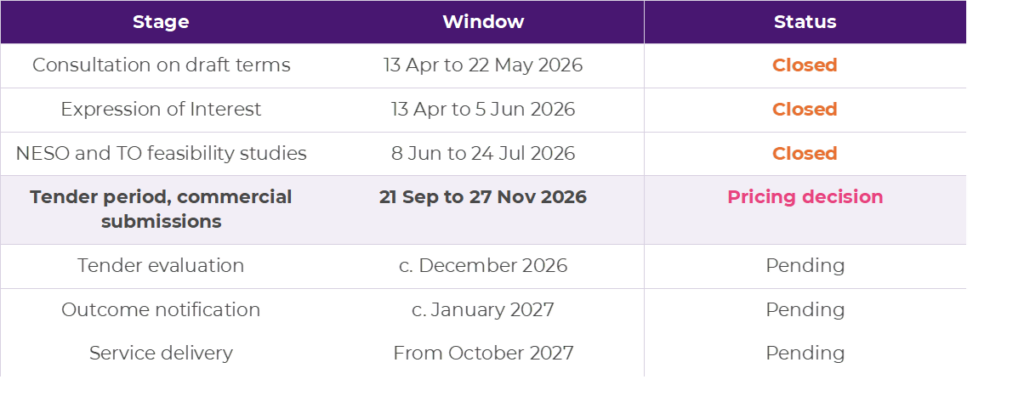
The EOI window has closed. For parties that passed feasibility, the live decision is the arming fee cap and intertrip fee submitted between 21 September and 27 November, and the effectiveness factor published at ITT will move that number more than any price forecast will. For parties outside this round, the openings are CMIS EC5-Enduring, the subsequent tender NESO has reserved the right to run, and the design consultations for whatever follows.
What to price
Every grid confronts its two constraints in sequence. First the capacity connected to it, then the capacity built to move that power across it. Europe is in the second phase everywhere at once.
What differs is what each market is willing to sell. Italy sells a 15-year annuity and cleared it at a third of its ceiling. GB sells a contingent, volume-linked payment with no availability component, no capacity payment and no contractual cap on exercise count, and has scoped its invitation to wind. Those are not two points on the same product curve. They are different instruments, and they belong in different parts of a capital structure.
The discipline transfers even where the instrument does not. Establish who is short the option. Quantify the carry against the specific hours in which it is actually incurred. Decompose the covariance rather than averaging it. Test the position on levered equity return, not on gross revenue. Only then decide whether the premium clears.
Every market prices the same problem differently. Blanboz builds the techno-economic case across all of them: modelling the revenue against the hours it is earned, optimising the bid against the odds of being called, and testing the position on levered equity return, not gross revenue. For CMIS and every mechanism it resembles across Europe. Get in touch to know your number before you submit.
Authors

Sanju Ale BEng MIET | BESS Project Consultant
Sanju's experience spans across energy, government and climate technology – bringing a rare combination of engineering and commercial depth to Blanboz. At Blanboz, he leads techno-economic modelling and AI product development and has already contributed to projects totalling 2.1 GWh across Europe.
Prior to Blanboz, he worked as an Analyst at the Scottish Government within the Ukraine division. His previous experience includes renewables project at the European Council for Nuclear Research (CERN) where he worked on energy-ΔT modelling, feasibility analysis, LCOE, and evaluating Franco-Swiss power and emissions markets. Sanju has also worked on start-up development with Barclays Eagle Labs, where he was part of multiple US-UK business development/fundraising programmes, and is a member of Techscaler.
E-mail: s.ale@blanboz.com | Sanju Ale | LinkedIn

Andres Blanco MEng MSc CEng MIET | BESS Project Consultant | Founder & Director
Andres is the Founder and Managing Director of Blanboz and a leading expert in the industry. With 15 years of experience in renewable energy, including the last 12 focused exclusively on battery storage, he has overseen the execution of more than 20 GWh of BESS and 7.5 GWp of solar PV projects globally, including the largest BESS deployment in UK history and some of the world’s most significant solar PV farms.
Andres has worked across a broad range of cell manufacturers and BESS integrators, spanning the full project lifecycle from early-stage design through construction, commissioning and operations. He has led technical contract negotiations for transmission-connected BESS across the UK and served as technical lead on some of the country’s earliest co-located BESS and solar deployments.
Prior to founding Blanboz, Andres held senior roles at Frazer-Nash, Wood and ScottishPower. His expertise spans the full energy value chain, from technical delivery to commercial strategy, and extends beyond infrastructure through his work supporting NGOs on energy access in developing countries. He is a Chartered Engineer, a BESS expert on the IMechE Renewable Power Committee.